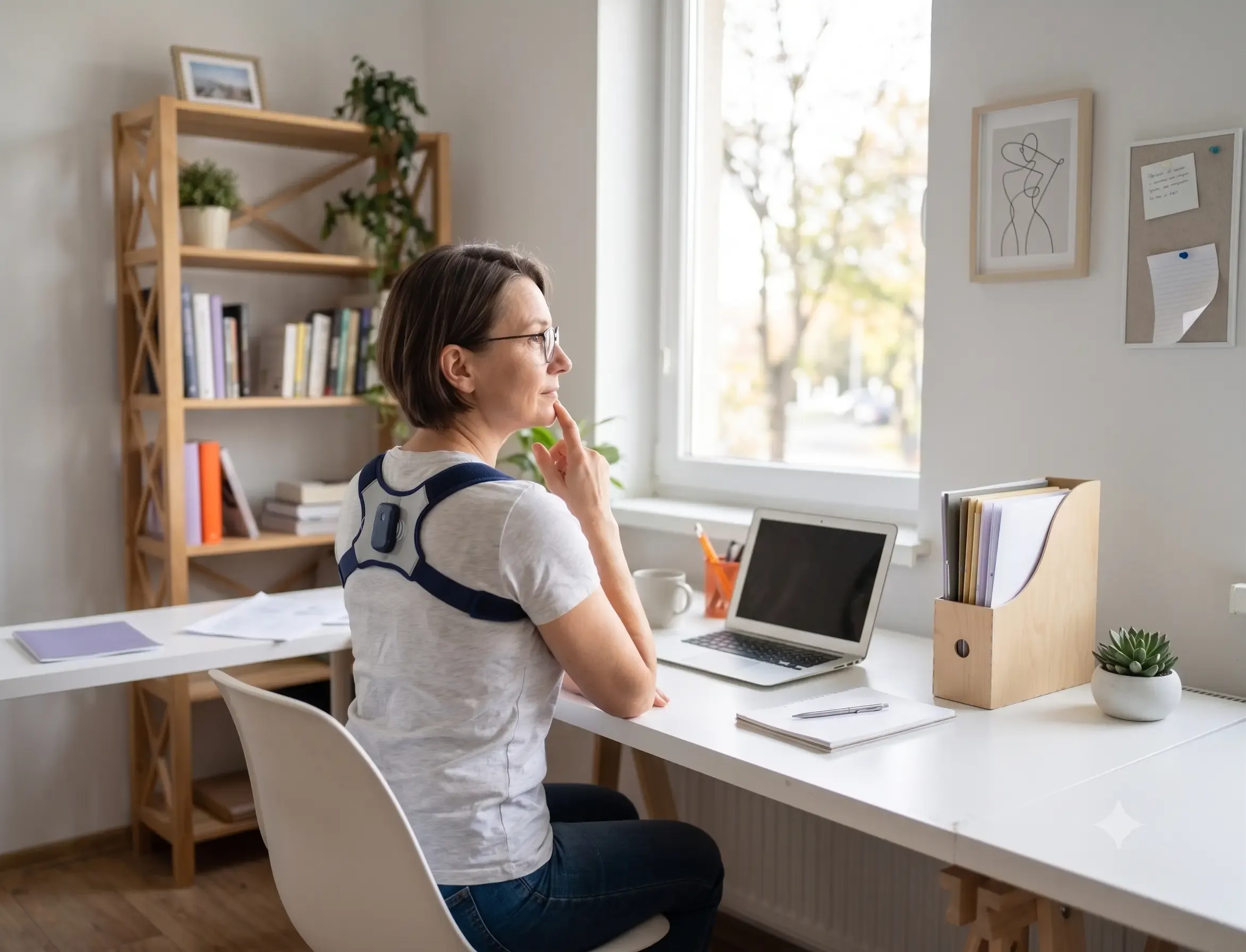
Posture Trainers with Vibration Compared: Which One Is Actually Worth It?
rectify and Upright GO 2 compared: measurement values, sensor position and configurable vibration feedback at a glance.
You're sitting upright, focused — and suddenly your posture trainer vibrates.
You didn't lean markedly forward. You just turned your head briefly because your phone rang. Depending on the selected training rule, the device may still vibrate.
Whether that cue feels appropriate in this situation depends on which movements a system captures and how its feedback rules are configured.
That is not a weakness of vibration. Posture trainers evaluate movement differently.
Upright GO 2 describes its feedback primarily as real-time detection of slouching. Its manufacturer page does not list separate detection of lordosis, lateral flexion or torsion. rectify differentiates these four values separately.
This comparison explains the differences in measurement, sensor position and configurable feedback.
Quick Take
- In this direct comparison, rectify separately captures four values: lordosis, sagittal flexion, lateral flexion and torsion.
- Upright GO 2 is a product considered here and remains available. The manufacturer lists a price from US$79.
- The rectify prevention course is certified under Section 20 of the German Social Code Book V. Statutory health insurers may subsidise participation, but each insurer determines its own amount and conditions.
What's Actually Available
This comparison focuses on rectify and Upright GO 2.
Upright GO 2 is worn on the upper back with an adhesive pad or necklace, according to the manufacturer. Its product page lists two motion sensors with a gyroscope, real-time feedback for slouching, nine feedback plans, adjustable vibration settings and up to twelve days of battery life at the recommended three hours of daily training. The manufacturer does not list separate detection of lordosis, lateral flexion or torsion. Price according to the manufacturer: from US$79.
Lumo Lift and Alex Posture Coach are frequently mentioned in older comparison articles. This article does not assess them as current purchase options.
| Device | Form factor | Captured or stated values | Location | Vibration configuration |
|---|---|---|---|---|
| rectify | Sensor shirt | Lordosis, sagittal flexion, lateral flexion, torsion | Lumbar spine | Pro: up to 5 parameters freely combined |
| Upright GO 2 | Adhesive pad / necklace | Feedback for slouching; two motion sensors with gyroscope. Separate detection of lordosis, lateral flexion and torsion is not stated. | Upper back | 9 feedback plans; adjustable vibration type and intensity |
Where the Sensor Sits — and Why It Matters
Here's a point almost every comparison article skips.
Upright GO 2 is worn on the upper back and provides real-time feedback for slouching, according to the manufacturer.
The product page does not list a separate lordosis measurement at the lumbar spine. That is a specific functional difference from rectify.
rectify's FlexTail sensor sits at sacrum level. This position enables the device to capture curvature in the lumbar spine area directly.
The calibration approaches also differ: according to the manufacturer, Upright GO 2 recognises the current body position before each use and adapts to it. rectify's flat calibration uses a defined zero point. The systems therefore use different references for their feedback.
The Four Dimensions That Actually Matter
The spine moves in multiple directions. During everyday movement, these directions can also occur together.
rectify differentiates four values separately:
Lordosis — the curvature of the lumbar spine.
Sagittal flexion — bending forward.
Lateral flexion — tilting sideways, for example with an off-centre monitor or phone.
Torsion — twisting of the torso, for example when reaching for a mouse or looking to one side.
Upright GO 2 describes its feedback as detection of slouching. Its manufacturer page does not list separate detection of these four values. Of the products directly compared here, rectify captures all four values separately.
Walkling et al. (2025) showed that the same FlexTail sensor data rectify uses for posture tracking can classify 22 different everyday activities with up to 98 percent accuracy — a sign of just how information-rich the signal actually is. Marx et al. (2023) deployed the sensor clinically: to measure range of motion after scoliosis surgery, across all four axes.
rectify: A Shirt That Knows Exactly What's Happening
The wearable concept isn't just about comfort. It's part of the measurement precision.
The sensor shirt fits close to the body and positions the FlexTail sensor at sacrum level. The fixed position on the body creates reproducible conditions for capturing and comparing posture values.
18 measurement points. 30 grams. Invisible under a normal t-shirt. Battery: 30 hours.
Behind the product is a spin-off from TU Braunschweig — over ten years of development, four published studies. Sawicki et al. (2026) validated the FlexTail sensor under real-world conditions on a construction site. Haghi et al. (2023) compared its measurements against video-based pose estimation. The technology comes from a clinical context and has been adapted for everyday use.
The Vibration That Actually Means Something
With the Upright GO 2, the manufacturer offers nine feedback plans and adjustable vibration type and intensity. Its feedback is geared toward slouching; the product page does not list separate adjustment for lordosis, lateral flexion or torsion.
rectify works on three levels:
Sitting alert — you've been sitting with poor posture for too long. Four frequency settings: from Instant (1-second cooldown) to Seldom (15 minutes). Three intensity levels: 33%, 67%, 100%.
Bending alert — you're bending forward with a flattened lumbar spine. The trigger threshold is configurable: at what lordosis angle? At what sagittal angle? Cooldown: 2 to 60 seconds — depending on whether you're tidying up or typing.
Custom profile (Pro Mode) — build your own alert. Combine up to five parameters: posture score (0–100), sagittal (±90°), lateral (±90°), torsion (±90°), lordosis (0–90°). Your own delay, your own cooldown, multiple profiles active simultaneously.
In practice, the rules can for example be configured so that brief movements irrelevant to the selected profile do not automatically trigger a cue. A defined combination of angle, duration and cooldown can instead provide targeted feedback.
Who Needs What?
Upright GO 2 makes sense if you are looking for a compact device that provides feedback for slouching. It is easy to set up, does not require a shirt and has a low entry price.
rectify is the right choice if:
- you want to capture lordosis, sagittal flexion, lateral flexion and torsion separately
- you want to understand when and how your posture changes in everyday life
- you want to configure feedback rules with multiple values, delays and cooldowns
On reimbursement: the rectify prevention course is certified by the German Central Prevention Certification Body under Section 20 of the German Social Code Book V. Statutory health insurers may subsidise participation in certified prevention courses. The amount and conditions vary by insurer, so check with your insurer before participating. The certification and any possible reimbursement apply to the prevention course, not to the sensor shirt.
Conclusion
A posture trainer that only measures one dimension isn't a bad product. It does what it promises. It reminds you when you're hunching forward.
Spinal movement can involve several directions. In the direct comparison, rectify captures lordosis, sagittal flexion, lateral flexion and torsion separately. Upright GO 2 does not list separate detection of these four values on its manufacturer page.
Rather than relying on superlatives, choose the measurement values and feedback rules that match your training.
Try rectify and learn more about the prevention course: rectify.de
Sources
- Marx C. et al. (2023). Postoperative spinal range-of-motion measurement after scoliosis surgery. DOI: 10.1055/s-0043-1761303
- Walkling A. et al. (2025). Human activity recognition with a wearable spine sensor. DOI: 10.3390/s25123806
- Haghi M. et al. (2023). Validation of the FlexTail sensor against video-based pose estimation. DOI: 10.3390/s23042066
- Sawicki S. et al. (2026). Spinal measurement under real working conditions, TU Braunschweig. DOI: 10.1007/s41693-025-00173-x
- Upright GO 2 product page. Retrieved 10 August 2026: https://store.uprightpose.com/products/upright-go2
- German Central Prevention Certification Body. Information on the certification process and reimbursement for certified prevention courses: https://www.zentrale-pruefstelle-praevention.de/